Vehicle Driveshaft Problems and Solutions
July 17, 2026
Your vehicle's driveshaft is one of the hardest-working components in the drivetrain. It transfers power from the transmission or transfer case to the differential, which then sends that power to the drive wheels. When everything is working correctly, you never think about it. When something goes wrong, the symptoms can range from a mild shake at highway speeds to a serious clunk that gets worse every day.
Driveline vibration, shudder, noise, and visible wear are not problems to push to the back burner. Left unchecked, these symptoms can lead to accelerated wear on related components, costly repairs, or — in severe cases — a driveshaft failure that leaves you stranded.
The good news is that driveshaft problems usually give you warning signs before they become critical. Understanding the different types of driveshaft issues, what causes them, and what to watch for can help you make better decisions about your vehicle and its drivetrain.
What a Driveshaft Does
The driveshaft — sometimes called a propeller shaft — is a rotating tube that connects the transmission or transfer case output to the differential. As the engine produces power, the transmission delivers it through the driveshaft to the differential, which splits and redirects that power to the drive wheels.
Most rear-wheel-drive and four-wheel-drive vehicles use one or more driveshafts as part of this system. Some vehicles use a single-piece driveshaft, while others use a two-piece design that includes a center support, known as a carrier bearing, to manage length and operating angles.
Because the driveshaft spins at high rotational speed and operates across a range of angles and loads, it depends on several key components — including U-joints, CV joints, and carrier bearings — to stay balanced, flexible, and functional.
Why Driveline Symptoms Should Not Be Ignored
Driveline vibration, shudder, clunking, and unusual noise are signals worth paying attention to. What starts as a minor annoyance can progress to worn joints, damaged seals, or a driveshaft that puts stress on the transmission, differential, and surrounding hardware. The longer a worn or out-of-spec component is left in service, the more damage it can spread through the system.
Types of Driveshaft Problems
Driveshaft problems generally fall into three broad categories. Understanding which category your symptoms point to can help narrow down where to start looking.
- Driveline-angle issues — problems caused by the driveshaft operating at incorrect angles between the transmission or transfer case and the differential
- Dynamic or rotational-speed issues — vibration related to balance, tube dimensions, material, or operating RPM
- Mechanical wear or damage — worn or failed components such as U-joints, CV joints, carrier bearings, and yokes
Each category produces different symptoms, though overlap is common. A vibration that feels like a balance issue, for example, may turn out to be an angle problem. That is why a complete driveline inspection is often more useful than chasing a single symptom.
Driveline-Angle Issues
Every driveshaft operates at an angle. Because the transmission or transfer case sits at a different height than the differential, the driveshaft must bridge that difference while still rotating smoothly. U-joints or CV joints allow that angular movement to happen.
The challenge is that these angles have limits. When the working angle between the driveshaft and the yokes on either end becomes too steep or too uneven, problems follow.
What Causes Incorrect Driveshaft Angles
Angle problems can develop for several reasons:
- Suspension or lift modifications — Raising or lowering a vehicle's ride height changes the position of the axle and differential relative to the transmission. A lift kit that was not paired with the correct pinion angle correction can create a steep working angle that the driveshaft was not designed to handle.
- Worn or collapsed suspension components — Sagging springs, worn bushings, or damaged mounts can shift the differentials position over time.
- Aftermarket or mismatched components — A replacement driveshaft or yoke that does not match the vehicle's specific geometry can alter operating angles.
- Incorrect installation — A driveshaft installed with the yoke phasing out of alignment can introduce angle-related symptoms even when the components themselves are correct.
Symptoms of Driveline-Angle Problems
Angle-related driveshaft problems often produce symptoms that feel more like a shudder than a steady vibration. Here is what to watch for:
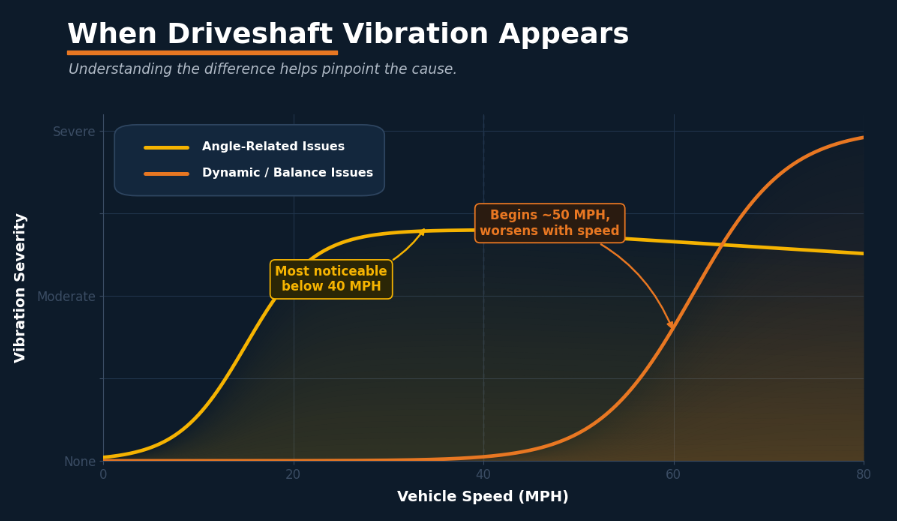
- A shudder or shaking sensation that is most noticeable at lower speeds, often below 40 MPH, during acceleration
- Symptoms that tend to ease or disappear at steady highway cruising speeds
- Vibration or shudder that becomes more pronounced under load — when pulling away from a stop, climbing a hill, or towing
- Binding, clunking, or a roughness that seems tied to drivetrain load rather than vehicle speed
- In more severe cases, interference between the driveshaft and the transmission or differential yoke, which can cause mechanical damage to both
A Note on Angle Specifications
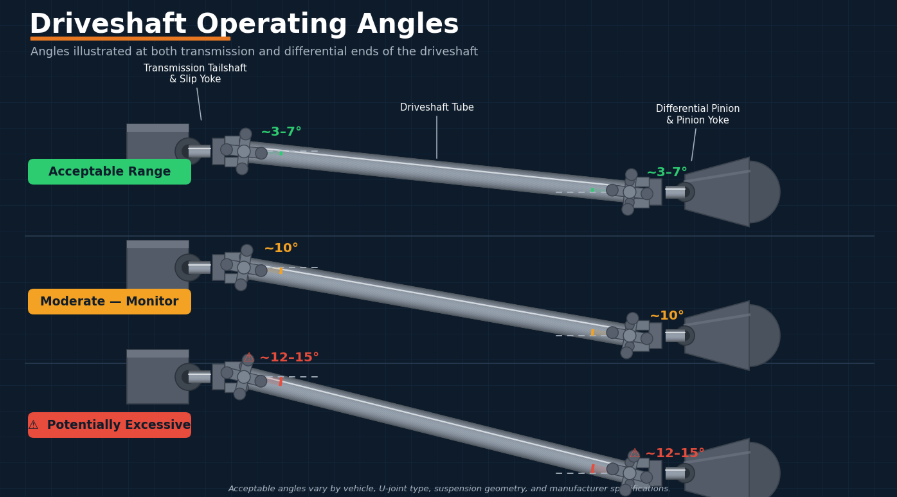
Acceptable driveshaft working angles vary depending on drivetrain design, U-joint type, suspension geometry, and the vehicle manufacturer's specifications. A range of roughly 3 to 7 degrees is sometimes cited as a general illustrative reference, but this is not a universal specification that applies to all vehicles or drivetrain configurations.
Angles in the 12- to 15-degree range may be excessive in many common applications, but whether they are acceptable depends on the specific vehicle, joint type, and how the system is configured. Always evaluate angle concerns against the manufacturer's recommendations for your specific setup.
Dynamic Driveshaft Issues and Higher-Speed Vibration
Not all driveshaft vibration is caused by angles. A second category of driveshaft problems is related to dynamic balance and rotational behavior — how the driveshaft spins, how well it is balanced, and whether its physical characteristics are matched to the speeds and loads it is asked to handle.
What Is Dynamic Driveshaft Vibration?
Dynamic vibration occurs when the driveshaft does not spin in a perfectly true, balanced arc at operating speed. This can happen because:
- The driveshaft is out of balance — a heavy spot causes the tube to wobble slightly as it spins
- The tube diameter, wall thickness, or material is not well matched to the driveshaft's length and the RPM at which it operates
- A longer driveshaft operating at high RPM without adequate stiffness or mass can become prone to harmonic resonance — a condition where the spinning tube begins to flex and amplify vibration at specific speeds
When Dynamic Vibration Appears
Unlike angle-related shudder, which tends to be most noticeable at lower speeds and under load, dynamic vibration typically:
- Begins at approximately 50 MPH or above
- Becomes progressively worse as vehicle speed increases
- May feel like a steady, speed-related buzz or shake through the floor, seat, or steering column
The direct relationship between driveshaft rotational speed and dynamic vibration is important to understand. The faster the driveshaft spins, the more any imbalance or stiffness mismatch is amplified.
How Gear Ratio and Tire Size Affect Driveshaft Speed
Driveshaft RPM is not the same as engine RPM. It is affected by vehicle speed, differential gear ratio, and tire height. Understanding that relationship can help explain why vibration appears at a specific speed — or why a modification changed when vibration occurs.
- Taller tires generally reduce driveshaft speed at a given MPH, because more ground is covered per revolution
- Deeper numerical gear ratios (such as 4.88s compared to 3.73s) generally increase driveshaft speed at a given MPH, because the drivetrain turns over more times per mile
If you have changed your tire size or gear ratio and want to understand how those changes affect your drivetrain, the
Gear Ratio Analysis Tool at Gears Unlimited can help you evaluate the relationship between your setup and driveline behavior.
Mechanical Driveshaft Wear and Damage
The driveshaft tube itself and its welded yokes are generally durable under normal operating conditions. In most stock applications, the tube and yokes do not fail on their own unless there is an unusual event — impact damage from road debris or an off-road obstacle, interference caused by incorrect angles or clearances, neglected maintenance on service items, or use that exceeds the drivetrain's original design limits.
What does wear out with use are the serviceable components: U-joints, CV joints, carrier bearings, and transmission yokes. When these parts are not maintained or replaced as needed, the damage they cause can eventually reach the tube, the weld yokes, and the rest of the drivetrain.
U-Joints and CV Joints
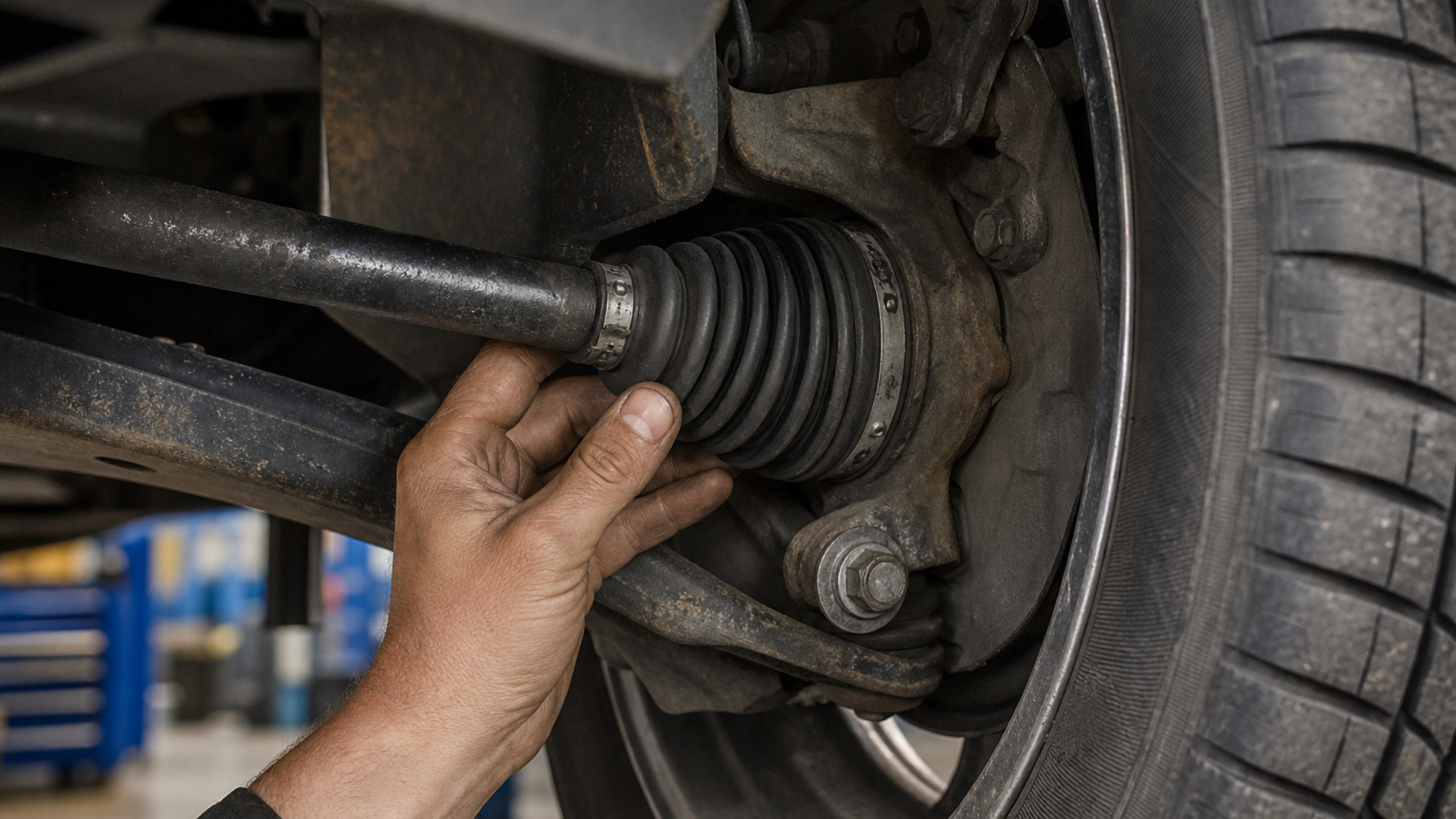
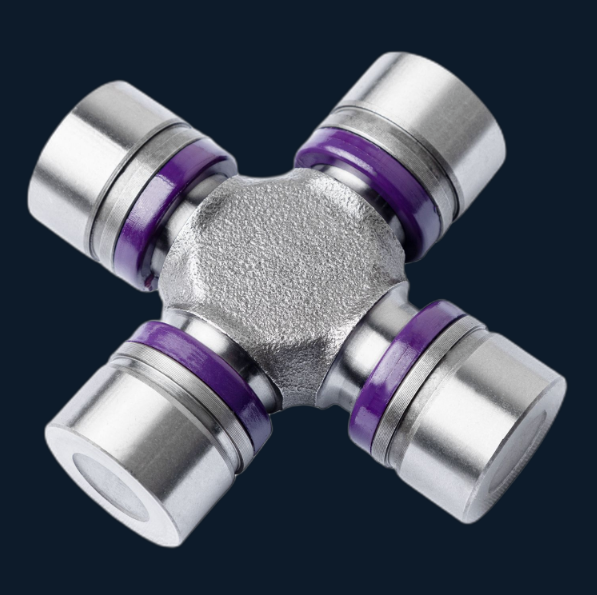
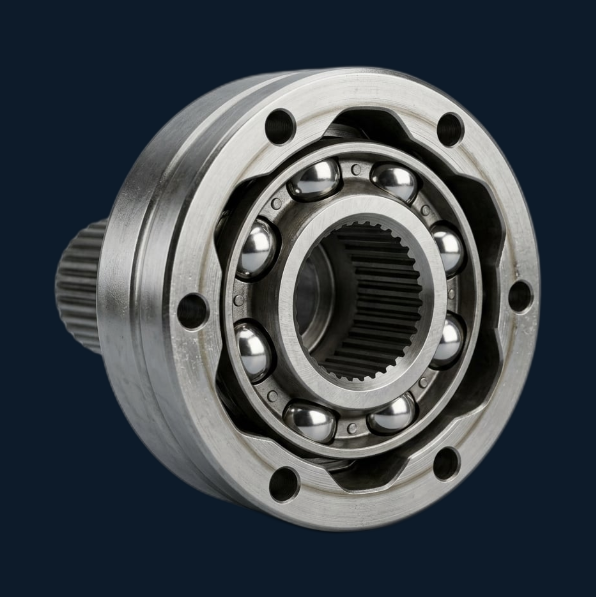
Universal joints (U-joints) are the cross-shaped, bearing-packed fittings that allow the driveshaft to change angle while continuing to transmit rotation. CV joints (constant-velocity joints) serve a similar purpose but use a different design to maintain more consistent power delivery through a greater range of motion.
Both are wear items. Over time, the bearings inside can dry out, rust, wear loose, or fail — especially if grease fittings are not serviced or if the joint has absorbed shock loads beyond its design range.
Bad U-joint symptoms include:
- A clunk or knock during gear changes or when transitioning between acceleration and deceleration
- Vibration that appears or worsens with driveshaft rotation
- Visible rust, pitting, or discoloration at the joint caps
- Looseness you can feel when rotating the driveshaft by hand
CV joint problems may also produce clicking or popping, particularly under load or when the joint is at a steeper angle.
Carrier Bearings
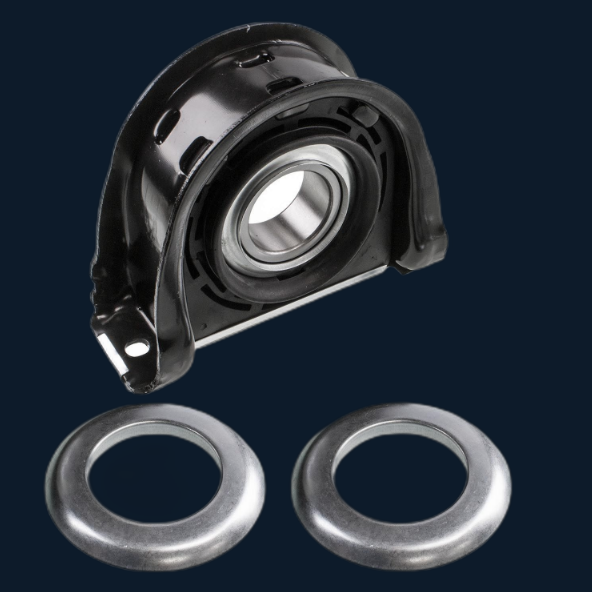
On two-piece driveshaft assemblies, a center support bearing — commonly called a carrier bearing — is used to support the midpoint of the driveshaft and maintain proper operating angles across its length. Some configurations use a carrier bearing combined with a CV joint at the same location.
Carrier bearing symptoms commonly include:
- A rattling, droning, or humming sound that increases with vehicle speed
- Vibration felt through the floor or driveline at highway speeds
- Roughness or grinding when the driveshaft is rotated
- A sagging or misaligned appearance at the center of the driveshaft when inspected from beneath the vehicle
- A worn or cracked rubber isolator that allows the bearing housing to move when it should be firmly mounted
When a carrier bearing fails and is not replaced, the driveshaft can begin to run at incorrect angles, accelerating wear on U-joints and eventually the tube assembly.
Transmission Yokes
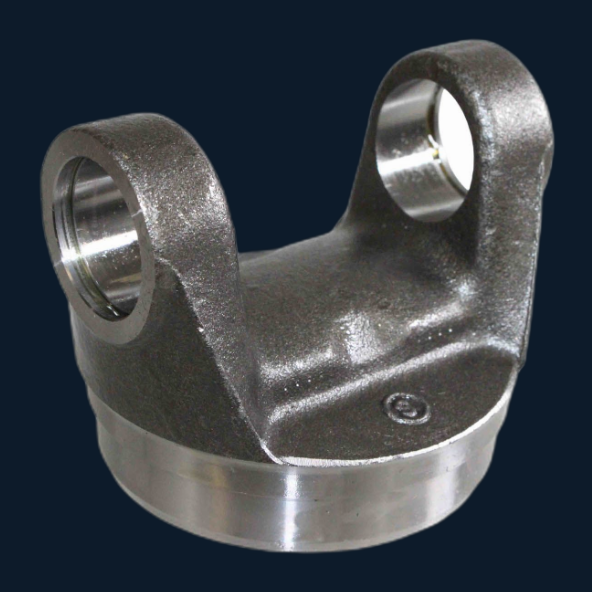
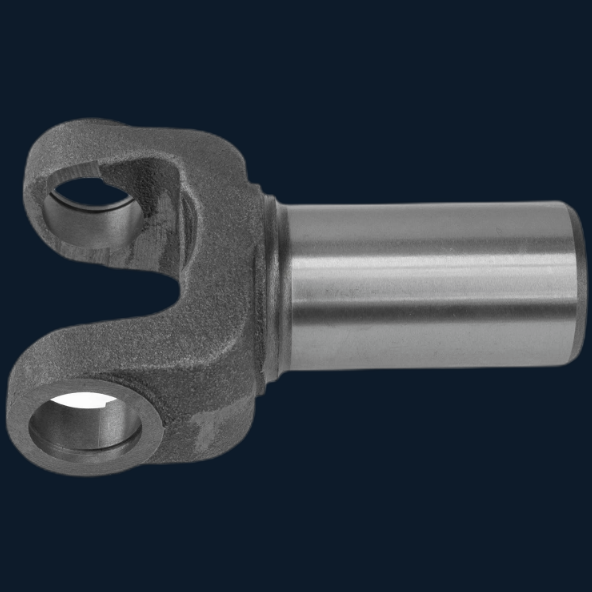
The transmission yoke (also called the slip yoke) is the component that slides onto the output shaft of the transmission and connects to the front of the driveshaft. It allows slight in-and-out movement to accommodate driveline travel as the suspension moves.
A worn transmission yoke can cause:
- Clunking during acceleration or deceleration
- Vibration related to looseness or wear in the slip spline
- Transmission fluid leaks at the tailhousing seal, which can occur when a worn yoke damages the seal surface
Impact Damage and Off-Road Hazards
Road debris, rocks, stumps, and trail obstacles can strike a driveshaft directly — bending the tube, cracking a weld yoke, or damaging a joint. Even a relatively minor impact can throw a driveshaft out of balance or introduce a bend that produces vibration.
If a vehicle has recently been driven through rough terrain or over a road hazard and begins showing vibration or noise shortly afterward, driveshaft impact damage should be among the first things checked.

What Happens When Wear Is Ignored
Neglected U-joints, carrier bearings, and transmission yokes do not just wear out in isolation. As they loosen and fail, they allow the driveshaft to move in ways it was not designed to. That movement creates stress on the tube, the weld yokes, and adjacent components. What began as a serviceable wear item can eventually cause damage that requires a complete driveshaft replacement.
Catching worn service parts early is almost always less expensive than replacing an entire assembly.
Quick Driveshaft Troubleshooting Reference
The table below summarizes the most common driveshaft problems, their symptoms, and suggested next steps. Use it as a starting point — not a final diagnosis.

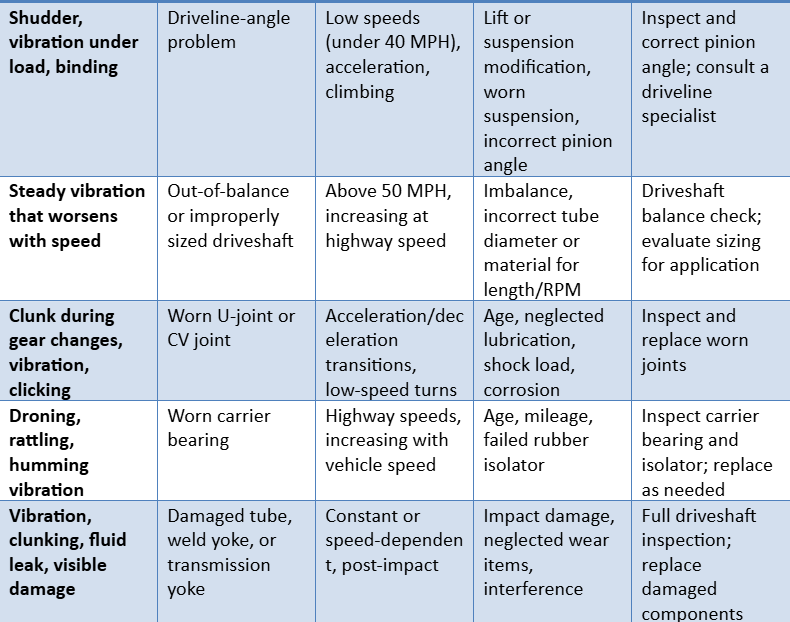
Important note: Driveline-like vibration, shudder, and noise can also originate from tires, wheels, wheel bearings, brakes, engine mounts, transmission components, or other vehicle systems. These symptoms are not always caused by the driveshaft. If symptoms are persistent, worsening, or difficult to isolate, a professional driveline inspection is the most reliable next step.
When to Call a Professional
Some driveshaft problems can be identified visually — a loose joint, a cracked carrier bearing mount, an obvious bend in the tube. Others require a lift, specialized tools, and experience to diagnose accurately.
If you are experiencing any of the following, it is worth having your driveline professionally inspected:
- Vibration or shudder that has not improved after basic checks
- A clunk or knock that is getting worse
- Symptoms that developed after a lift, suspension modification, or tire and gear ratio change
- Any grinding, rubbing, or intermittent contact noise coming from beneath the vehicle
- Symptoms you cannot reliably reproduce or isolate
Driving on a seriously worn or damaged driveshaft puts the rest of the drivetrain at risk. Catching it early is almost always the better outcome.
Get Help From Gears Unlimited
Driveshaft problems are not always straightforward. An angle issue can feel like an imbalance problem. A worn U-joint can feel like a tire issue. And vibration from a failing carrier bearing can look a lot like a transmission concern.
If you are dealing with driveline vibration, noise, shudder, or visible wear — or if you have recently modified your suspension, changed your tire size, or regeared your axles and are now experiencing symptoms you did not have before — the team at Gears Unlimited can help.
From driveline inspection and diagnosis to driveshaft repair, replacement, and custom driveshaft guidance, Gears Unlimited has the expertise and components to address what is going on under your vehicle. Contact Gears Unlimited today.